New York, December 8th, 2024
Duane Michals in conversation with Hans Ulrich Obrist
I do this movement against the disappearance of handwriting. And I realised in all your works, handwriting plays such a crucial role.
DM I love it. I love handwriting. I think when man began to write, that’s when they became civilised. Young people today don’t write. I really love to see books where there’s famous people’s handwriting. I think it says who you are, the way in your handwriting is very important, very intimate, very personal.
I think so too. And when did you start to use handwriting?
DM I always did it, from the very beginning. I guess when I was in the army in Germany. Letters are very important when you’re a soldier. I mean, you live off of your letters. And I’ve always liked, prized handwriting.
I saw a film from about 10 years ago, the Pittsburgh Museum came to film you. And they filmed you here in the archive. And it feels even more dense, which is great.
DM This is the essential me. I’m looking for my army book. I don’t know where it is.
Because you’ve done so many books in your life.
DM That’s the only thing. I’ve done 45 books.
I was actually thinking there should be a book about your books, it exists about some artists like Gerhard Richter. It doesn’t really exist so much about photography, but I think with photographers Helen Levitt. I went to her house and did an interview with her. It was very beautiful. The cat was between her and me on the table. And Helen suddenly said, at the end of the day, as a photographer, what matters is books. I don’t understand these blown up prints. Huge photography needs to be intimate. And it’s the same like with you and the books, no?
DM I love intimacy. Photography is like whispering. When you write something, it’s like whispering. I’m very touched if I see handwriting of maybe something by De Chirico (I love De Chirico and Magritte). To me, that’s like drawing. Writing is like drawing. And you can’t duplicate it. It’s very intimate.

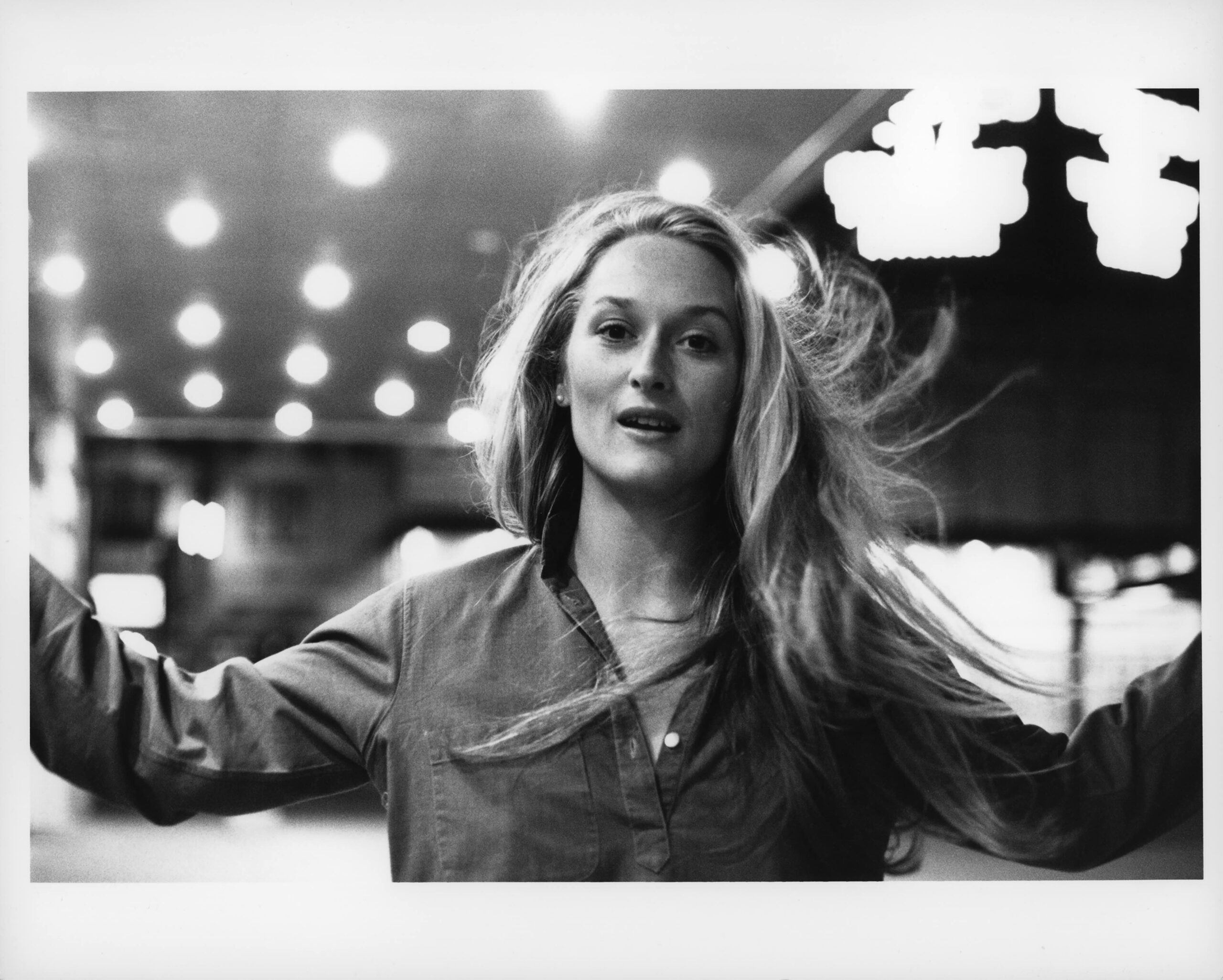
Meryl Streep, 1975. © Duane Michals. Courtesy of DC Moore Gallery, New York.
“I think everything is a dream. My position in photography has not been traditional. I’ve not been particularly interested in looking for life or reproducing reality. I’m interested in metaphysical issues. I’m interested in dreams. And I think they’re more a valid subject, because they’re so personal to you, as opposed to observations.”
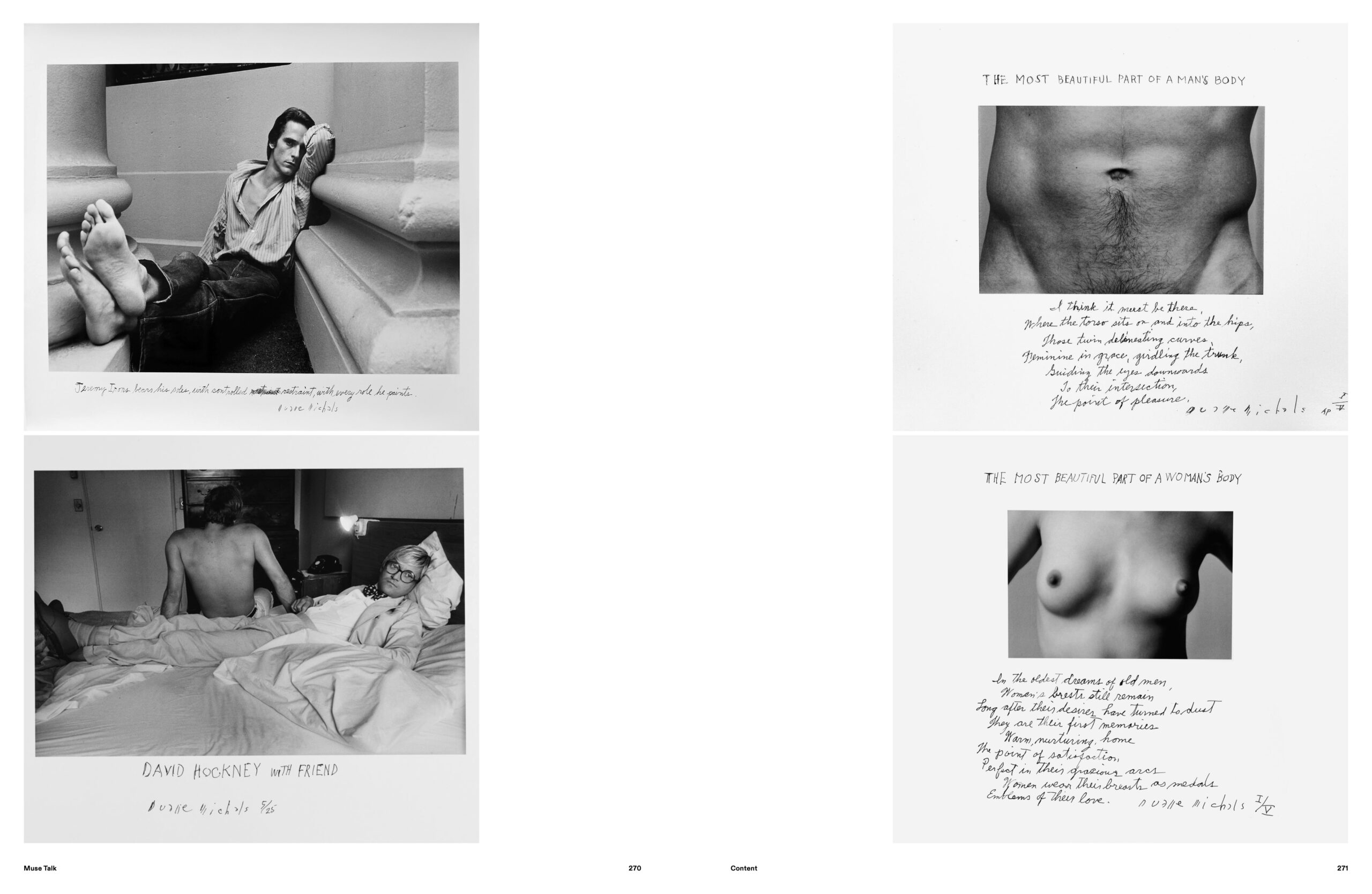
David Hockney with Friend, 1975. © Duane Michals. Courtesy of DC Moore Gallery, New York.
The Most Beautiful Part of a Man's Body, 1986. © Duane Michals. Courtesy of DC Moore Gallery, New York.
The Most Beautiful Part of a Woman's Body, 1986. © Duane Michals. Courtesy of DC Moore Gallery, New York.

It’s also to do with dreams.
DM Very much so. I think everything is a dream. My position in photography has not been traditional. I’ve not been particularly interested in looking for life or reproducing reality. I’m interested in metaphysical issues. I’m interested in dreams. And I think they’re more a valid subject, because they’re so personal to you, as opposed to observations. I’ve always had writing in my books. I’ve always considered that. And photographers usually consider that a failure. Somebody said that my work was so bad, I had to write out to explain it. It completely missed the point of the intimacy.
No, it’s the opposite. It also helps to see what we’ve never seen before.
DM Always. And you could talk about things. You could talk about feelings that you cannot see in somebody’s face. I mean, the more and more intimate the work is, the more private, the more touching. There’s consensus reality. We would all agree when you walk down the street, you go to Times Square, you see the signs. But I had to do something about that. I wrote a lot about being there. Writing completes expression. To photograph something is one form of expression, but it’s completely filled when you write it.
So it becomes a complete work.
DM Observation, photographing anonymous people on the street, to me is entry level. That says nothing. So the more intimate the expression, the more profound it is.

Do you have any photographers or artists from the past who inspired you?
DM Atget’s Paris. All of those street scenes look like stage sets. I kept waiting. And when I did my empty New York, I did it inspired by him, in the same way. I had one particular photograph, which was important: it was a barber shop. It was empty. On the wall, there was a hook and it was the white jacket that the barber wore. So the barber would come in and take his coat off and put on his white jacket. And to me, he was an actor. He would do his barber act.
That sounds almost like August Sandor.
DM Yes. The thing is, I began to see where I went, where August Sander didn’t go, and other people who did that kind of photography. I began to see this barber shop as a stage. Then, I began to see the barber as an actor.
Like a drama.
DM Like this is my stage and these are my props. He would come in every day, put on his white jacket, and then do his barber act all day. I began to see everything as a stage set. That led me to doing sequences. I took some people. There was Balthus’ The Street Scene at MoMA that I always loved. I always went to visit. It’s a very artificial street. It looks like a stage set. A man’s crossing the street.

It’s metaphysical.
DM Totally.
Like De Chirico.
DM He is my absolute favorite. De Chirico, Magritte, and Balthus. I got to photograph all of them. So that was my great reward as a photographer, is that I could take their picture.
Do you have any unrealised projects? Like for people you wanted to photograph?
DM No. I’ve been very lucky. And I chose anybody. I liked Saul Steinberg, and I did photograph him. Robert Frank, on the other hand, always intimidated me. One night I went into a restaurant where he used to eat with his wife. He asked me to join them for dinner. And I said, no. And you know why I said no? Because I couldn’t imagine what could I possibly say to Robert Frank. It’s like, what could I say to Picasso? I mean, it was my problem. He was very generous, but I was intimidated. And I was intimidated by De Chirico too. I got a picture, but I was so in awe.
Magritte was less intimidating?
DM He was intimidating, but I was there for a week. I had a whole week. If you’re in somebody’s house for an hour, you don’t have much time to work.
My friend Gerhard Richter, the German artist, always talks about chance coming to help. What’s the role of chance in your work?
DM Oh, I love chance. Where I could take a photograph, that wasn’t about facts. I took a photograph about things like chance. And chance is very important. Do you believe in luck? I’ve always been very lucky. I’ve never understood.
But I think one can provoke chance. It’s almost like…
DM Opportunities, you have to seize the moment. Do you believe in ghosts?
Phantoms and ghosts, always. I used to live in the Sir John Soane’s Museum, the 19th century museum. I lived in their guest room. There were ghosts.
DM After my mother died, I saw her ghost. We have a very old house in the country, where the garden is, and I saw a ghost. I’m very curious about life after death. My first book I did is The Spirit Leaves the Body, then the photograph Death Comes the old Lady, and I did one where a man in a subway becomes a star. So I’ve always dealt with metaphysical issues.
And now again, that’s still of your interest.
DM It’s still there. And the second book I did was The Journey of the Spirit After Death, which is based on The Tibetan Book of the Dead. So this is a very important question. I don’t like photography as description. I like it as theatre and drama.
You talk about four different portraits, the stand, the prose, the annotated, the imaginary.
DM Yes, I have kinds of portraits. Stand and Stare, that’s Diane Harbus, that’s August Sander, that’s the traditional photograph, passport picture, Avedon. And the second one is annotated, where I photograph my mother and father and family, and I wrote about them. Then the third one was Prose. When I took a picture of my mother, my father, and my brother, it shows you what they look like, but I had to talk about the relationships, and photography fails. Photography describes, but it doesn’t reveal.
And then there’s the Imaginary Portrait.
DM That’s the one I did with Tilda Swinton. I did that picture of her where she has a coat on backwards and she’s holding a mirror. She’s a genius. She’s into poetry. I think poetry is the highest of all the arts. I love to describe something. If it’s poetic, that’s beyond any other description.
Let’s talk about your books.
DM I’ve done lots of books. There’s a lot of writing in everything I do. I’m talking about two people about doing books, it’s 50 years of sequences, one is Steidl. And then Thames & Hudson wants to do something. And I want to do something called… Expression. To me, it’s called Duane Michals, the Expressionist. It’s how do you express yourself, whether you use photography, writing, painting, whatever it is. It’ll be about my text, about my painting, about my writing. It’s not about the category. It’s what you have to say. Sometimes it’s appropriate to write. Sometimes it’s appropriate to take a picture.
And have you collaborated with poets?
DM I’m not good at collaborating with anybody. A couple of poets have asked me to do something about their books, but I was never happy with it… Have you seen our movies? I’ve made 90 little movies. We do a movie every week. You must see them.
Read the full interview on Muse February Issue 65.